Aug. 24, 2012
Time's a-Wastin' to Vote for VCU’s Rare Artifact
Share this story
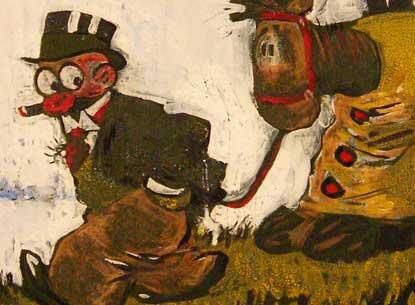
You can’t miss it. When you walk through the double doors into Special Collections and Archives on the fourth floor of James Branch Cabell Library, you cannot help but spot the green door propped in the corner.
This is no simple door. It hung at the office of famed comic artist William "Billy" DeBeck. A pioneer in the art form, DeBeck reflects the humor, culture and style of the 1920s and '30s.
During the Jazz Age and the Great Depression, DeBeck's Barney Google along with the racehorse, Spark Plug, were icons much like Calvin and Hobbes and Doonesbury and Zonker are now. Catchphrases he coined — ”horsefeathers!" “hotsy totsy,” “balls of fire,” "heebie-jeebies," "jeepers creepers!" and "time's a' wastin'" — were part of the national lexicon.
While DeBeck isn’t a household name today, his influence on the comic arts world is substantial.
“Comics fans who are into superheroes don’t know DeBeck but any serious collector or scholar knows the name well,” said Cindy Jackson, archival assistant for comic arts. “He is an important part of comic art history. ... He was one of the big names. People at the time wrote about his characters in songs and featured them all over the place. He was a big part of the pop culture at the time.”
Famed showman and songwriter Billy Rose wrote the pop tune “Barney Google,” with the refrain “Barney Google, with the goo-goo-googly eyes.” A celebrity himself, DeBeck was often seen and photographed with other big names, including boxer Jack Dempsey, baseball’s Dizzy Dean and singer Rudy Vallee.
In the ‘30s DeBeck developed an interest in Appalachia and hillbilly culture and invented the moonshiner Snuffy Smith. When Barney Google inherited a house in North Carolina, he and Snuffy met. Eventually, Snuffy Smith became the principal character and moniker for the strip.
Beyond his impact on pop culture, DeBeck’s art stands up well and can inspire students.
“His art is very beautiful. Drawing and art majors can learn a lot from his work,” Jackson said.
His distinctive “bigfoot” style of characters influenced later comic artists. Works by underground comic artist Robert Crumb saw wide use of the style as did the strips "Hagar the Horrible" and "The Katzenjammer Kids."
Like many illustrators and cartoonists, DeBeck’s work was not exclusive to the comic strip. For instance, the door at Cabell, which he painted in oil, is an art piece in its own right. Donated in the 1970s by one of DeBeck’s assistants with ties to Virginia, the door needs restoration. VCU Libraries hopes to raise the funds to both restore the work and encase it properly in a museum-quality display case.
VCU Libraries’ extensive comic arts collection of more than 40,000 comics is housed in Special Collections and Archives at Cabell Library. It is the only such comic arts research center in Virginia and one of the best in the nation.
Study of the comic arts offers primary source material useful to research in history, culture, art, English, mass communications, advertising and other disciplines that explore 20th century art, storytelling and American culture.
| The door is under consideration as one of the Virginia Association of Museums Top 10 Endangered Artifacts, a campaign designed to raise awareness about the importance of preserving and sharing artifacts of history and culture. Support VCU by voting for the DeBeck door at http://www.surveymonkey.com/s/vatop10. Voting ends Aug. 29. The door is available for viewing on the fourth floor of Cabell Library during regular hours. |
Subscribe to VCU News
Subscribe to VCU News at newsletter.vcu.edu and receive a selection of stories, videos, photos, news clips and event listings in your inbox.