Dec. 6, 2013
Two VCU researchers honored by American Association for the Advancement of Science
Share this story
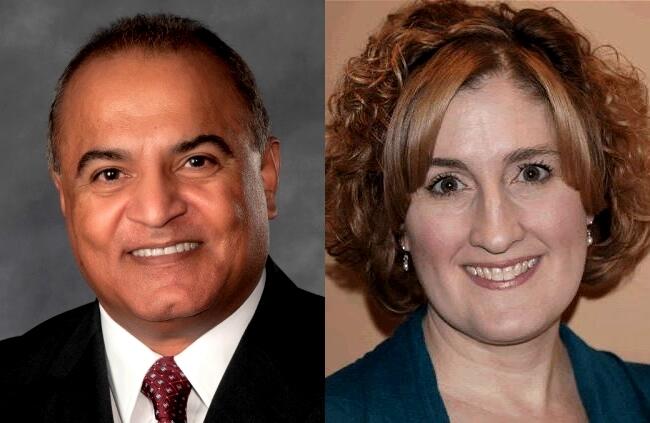
Two Virginia Commonwealth University professors have been named fellows of the American Association for the Advancement of Science (AAAS).
M. Samy El-Shall, Ph.D., professor of chemistry and physical engineering in the Department of Chemistry, part of the College of Humanities and Sciences, was recognized for distinguished contributions to the fields of clusters, nucleation, nanostructured materials and nanocatalysis, particularly for the novel synthesis of advanced nanomaterials.
Karen A. Rader, Ph.D., associate professor in the VCU Department of History, part of the College of Humanities and Sciences, was recognized for distinguished contributions to the history of the modern life sciences and for exceptional service to the discipline of the history of science. Rader is director of the Science, Technology and Society program at VCU.
El-Shall and Rader were among 388 individuals honored by the AAAS on the basis of their scientifically or socially distinguished efforts to advance science and its applications. The election as a fellow is an honor bestowed upon AAAS members by their peers. New fellows will be recognized and presented with an official certificate and a gold and blue rosette pin at the AAAS Annual Meeting in Chicago on Feb. 15, 2014.
El-Shall’s research interests are focused on the design and synthesis of nanoscale materials of controlled size, shape and composition for energy and environmental applications. The application of nanomaterials to help solve the current energy problems is recognized as one of the top priority research areas in science and engineering.
“It is an honor to be elected fellow of the AAAS,” El-Shall said. “Professionally, this is a great recognition of the research efforts in my lab at VCU over the past 24 years. This is also great recognition to the area of nanomaterials, especially nanocatalysis, for energy and environmental applications. Our research in these areas is focused on creating nanomaterials in order to contribute to meeting global challenges in the limited supply of fossil fuels, their adverse effects and a growing worldwide demand for clean energy.”
El-Shall was one of 13 research scientists and engineers selected nationwide as a 2012-2013 Jefferson Science Fellow at the U.S. State Department. He spent a year working as a senior science advisor to the Middle East Regional Cooperation (MERC) Program. This program promotes cooperation between Arab and Israeli scientists, technicians, students and communities by supporting research projects to solve common development problems. He has continued his work in this area and is currently establishing a new program that will help young scientists gain professional experience while building enduring research cooperation in this critical region of the world.
Rader’s research interests explore the popular and scientific history of biology and biomedicine in social and cultural context. Her areas of interest include “big science,” the relationships between science and government and science and art, animals in laboratory research and the interactions between laboratory research and popular views on science. Her new research will explore the history of science in K-12 STEM education.
“I am deeply honored by the recognition of my peers in the AAAS Section L, who I consider to be among the most socially engaged scholars and teachers in the field of science, technology and society and whose strong commitment to public science education and scientific historical awareness I share,” Rader said.
She has published numerous articles in history and science journals and has contributed chapters to edited volumes including, “Revisiting Women, Feminism and Developmental Biology.” Her first book, “Making Mice: Standardizing Animals for American Biomedical Research, 1900-1955,” chronicled the history of the laboratory mouse’s development and use in American biomedical research.
“Life on Display: Revolutionizing American Museums of Science and Natural History, 1890-1990,” Rader’s second book, which is forthcoming, looks at how ongoing efforts to create popular educational displays compelled public natural history and science museums in the United States to develop new institutional identities in 20th century science and culture.
Rader has received a number of honors for her research accomplishments, including a Mellon Post-Doctoral Research Fellow in the History and Social Study of 20th Century Life Sciences at MIT from and a Research Fellow at the Davis Center for Historical Studies at Princeton. She held a visiting professorship at the Institute for Advanced Study at Lancaster University in the United Kingdom. She was awarded a National Science Foundation CAREER Grant for “Biology on Display: Museums and the New Life Sciences in America.” In 2004, “Making Mice” won a CHOICE Outstanding Academic Book award.
The tradition of AAAS fellows began in 1874. The AAAS is the world’s largest general scientific society, and publishes the journal, Science. AAAS was founded in 1848, and includes approximately 262 affiliated societies and academies of science, serving 10 million individuals.
Subscribe for free to the weekly VCU News email newsletter athttp://newsletter.news.vcu.
Subscribe to VCU News
Subscribe to VCU News at newsletter.vcu.edu and receive a selection of stories, videos, photos, news clips and event listings in your inbox.