Feb. 11, 2011
VCU da Vinci Center Students again Perform “InnoBlitz” at Science Museum of Virginia
Share this story
Shadia Lahham and Kelly Grau were nervous when they arrived at the Science Museum of Virginia in the late afternoon of Jan. 28. Lahham and Grau were among a cast of students from the Schools of Arts, Business and Engineering selected to participate in the second InnoBlitz through VCU’s da Vinci Center for Innovation and neither was sure what to expect.
The InnoBlitz is a 24-hour innovative exercise in which VCU students complete a project assigned to them by the Science Museum. The first InnoBlitz in the fall semester was to create an exhibit that depicted the experience of the Chilean miners trapped underground. Students responded with an interactive design that showcased the tight confines of a mine shaft and the challenges of the miners’ situation.
When Lahham, Grau and their fellow students showed up to receive their assignment, they did not know what to expect – only that their task would need to be completed in just 24 hours. Lahham, who studies illustration in the School of the Arts, and Grau, who studies marketing in the School of Business, each was feeling insecure about how they would contribute to a museum project with their particular set of skills.
Once the assignments were doled out, however, participating students began to slide into roles naturally and to bring their own backgrounds and experiences to the challenges presented. Lahham was part of a group that redesigned a classroom, while Grau and her team created an exhibit to accompany the museum’s “Arctic Adventure” exhibition, which highlights life in the Arctic Circle. Each team worked with a budget of $500.
Few members of either team managed even a wink of sleep during the blitz, which ended late in the afternoon of Jan. 29 with both assignments completed.
For the classroom project, which happened in a room called the Constellation Room, Lahham and her teammates re-painted the room and worked to enliven the atmosphere with images and text that encouraged learning and curiosity. New features were added to the room to aid a collaborative vibe.
“We really wanted to make the room interactive because that’s such an important part of the Science Museum,” Lahham said.
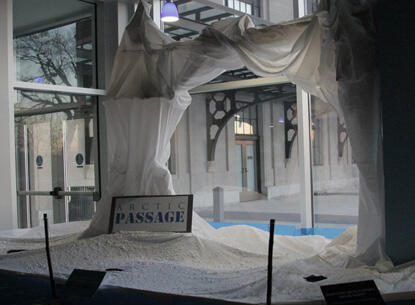
Grau’s team, meanwhile, created an exhibit, “Arctic Passage,” which was also designed with an interactive purpose at its core. The exhibit is built in the shape of an ice bridge and cleverly uses the activity of ice fishing to captivate kids. Exhibit visitors are greeted by a question regarding the natural world in the Arctic. In order to get the answer, the visitors go “fishing” into one of the holes in the ice. The fish down the holes are marked with the answer to the question.
Grau said at the center of the InnoBlitz experience was learning to work with teammates with diverse skills and perspectives while sleep deprived and under deadline pressure.
“Everybody had the same end goal but because we were coming from different academic disciplines we came at it with different means in mind,” Grau said.
Subscribe to VCU News
Subscribe to VCU News at newsletter.vcu.edu and receive a selection of stories, videos, photos, news clips and event listings in your inbox.