Feb. 15, 2011
VCU Dance NOW Program Features Reconstruction of Emotional 'Shelter'
Share this story
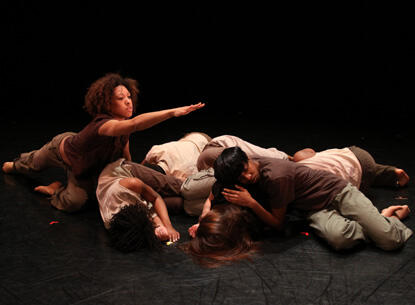
Seven students in the VCU Department of Dance and Choreography recently completed a full rehearsal of “Shelter,” the dance they will be performing this week for the annual VCU Dance NOW concert. The students tackled the rigorous 22-minute work for a small audience that included Jawole Willa Jo Zollar, “Shelter’s” choreographer, who was visiting for a week of practice. Following the climactic sequence that ends the dance, several of the students began to cry, spent from the emotional demands of what they had done.
Jaime Dzandu, one of the students in “Shelter,” said the response was unexpected even to the dancers but also indicative of the work’s poignancy. Dzandu believes those who come to see “Shelter” this week will discover a dance of great energy and compelling intimacy.
“The audience is going to feel a deep emotional connection to this work,” Dzandu said.
“Shelter” is one of a number of works on the program for VCU Dance NOW this year. Also to be featured are dances choreographed by guest artist Stefanie Batten Bland and VCU dance faculty Martha Curtis, James Frazier, Scott Putman, Melanie Richards, Judith Steel and Christian von Howard. VCU students dancers have been working on the dances since the fall semester.
VCU Dance NOW concerts will be held Feb. 17-19 at 8 p.m. in the Grace Street Theater, 934 W. Grace St. Tickets are $20 and $15 for students and may be reserved at http://www.showclix.com or by calling 804-828-2020.
Zollar choreographed “Shelter” in 1988 as an exploration of homelessness and displacement, resulting in a work “so filled with compassion and anger that it becomes a powerful incantation against the evils of obliviousness and neglect,” according to a New York Times review.
The version of “Shelter” to be re-staged at VCU examines the same issues through the lens of the aftermath of Hurricane Katrina in New Orleans. The work is being produced through a National Endowment for the Arts American Masterpieces grant.
Frazier, chair of the Department of Dance and Choreography, said there were several reasons the department pursued the grant for a staging of “Shelter,” starting with its stirring power. Lea Marshall, an assistant professor of dance and choreography, said “Shelter” explores issues of community that echo the dance department’s own focus on community. Members of the dance department also were familiar with Zollar and her dance company, the Urban Bush Women, who had served as visiting artists at VCU for seven weeks in 2007 and had proved exceptionally generous and popular with the Richmond community.
Two members of the Urban Bush Women visited in the fall to work with the dancers preparing to perform “Shelter.” Marshall said the close engagement with the professional performers was invaluable experience for the students, particularly because one of the visiting dancers, Samantha Speis, is a VCU dance alumna whose professional success served as a kind of road map for the students.
“It was a very intensive experience for them in the fall,” Marshall said. “It was not just about showing them the movements but about engaging in the work and working on just what this dance was going to convey.”
Frazier also worked with the VCU dancers in rehearsals. He said the students expertly mastered the physical requirements of the dance so that when Zollar visited this semester for a week “she was thrilled with the way the VCU dancers were handling the material” and she could focus on the thematic and emotional contents of the work.
Frazier said that “Shelter” requires “a deeper level of investigation” than most dances for its performers.
“It’s a deeply evocative work and it requires that performers go to some deep places,” Frazier said. “They have to go to some of their own experiences to get there.”
Dzandu said the group performing “Shelter” has grown close in the months that they have been working on it. With a laugh, she said that she’s “looking forward to seeing the seven of us survive to the end of this.” The piece has been rich with discovery for the students, and they are eager to see what they will learn during the performances in front of live audiences.
“We’re always finding new places in this work,” Dzandu said. “I want to see what else we can find – what else we can find further in the work to make it more beautiful.”
Subscribe to VCU News
Subscribe to VCU News at newsletter.vcu.edu and receive a selection of stories, videos, photos, news clips and event listings in your inbox.