Oct. 24, 2005
VCU develops nationwide trauma system, trauma course in Amazon jungle
Share this story
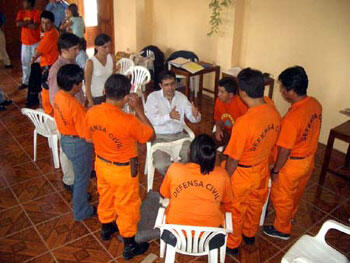
The Virginia Commonwealth University Medical Center, working with health care providers in Ecuador, is developing a system for preventing and managing trauma injuries in the Amazonian provinces of the western South American country.
Developed by the VCU Division of Trauma’s International Trauma System Development Program (ITSDP), the system was created along with a basic trauma course to educate the area’s own health care workers, administrators and directors on the proper definition of trauma, classification of trauma injuries, mechanisms of trauma and basic management of a trauma patient.
The project is a collaborative effort among VCU and various organizations and universities in Ecuador, including the University of Azuay, the Cinterendes Foundation and the Ministry of Health of Ecuador.
This is not the first time VCU has worked in Ecuador. Ronald Merrell, M.D., professor in the Division of General Surgery, previously established a telemedicine integration project in Ecuador and already had contacts in the country. Aware that Ecuador lacked some resources, Merrell and Ecuador’s director of health approached Michel B. Aboutanos, M.D., assistant professor of surgery and director of the ITSDP, to develop a trauma system in the Amazon jungles of Ecuador.
Aboutanos began his activities in the Amazonian province of Morona Santiago, one of the largest of Ecuador’s 22 provinces, and continued into Quito, the capital of Ecuador, where he evaluated trauma care and assessed the management of trauma patients in the province.
“Trauma care and management in the province of Morona Santiago was rudimentary,” said Aboutanos. “A basic definition of trauma was lacking throughout the medical community among the hospital directors, subdirectors and the medical personnel, and this was the case in all of the hospitals and records we evaluated.”
According to Aboutanos, trauma injuries across the province were not uniform, and they differed depending on the state of development in certain areas and the geographical location. In addition, one of the area’s major challenges was deciding between stabilization and transfer versus on-site management of the traumatized patient. Aboutanos said the ability to make either decision was compromised because of lack of knowledge, equipment and personnel.
With the help of team members such as Francisco Mora, M.D., a postdoctoral fellow in the Department of Surgery, and Edgar Rodas, M.D., former VCU surgical resident, both Ecuadorian natives, Aboutanos used a “patient pathway system” to trace the management of the patient from the initial site of injury to the health care posts, provincial hospitals and later to definitive referral centers.
The course stressed basic trauma management of patients in a rural setting. The objective of the course was to deliver a reasonable systematic approach, given the resources available, to the management of patients who sustained traumatic injuries.
“The local participation was impressive, and the impact will clearly be felt in the empowerment of the local physicians and health care workers in the appropriate care of the traumatized patient in Morona Santiago, Ecuador,” Aboutanos said.
Since the VCU team first presented the course, recent activities in Ecuador have included the establishment of:
• a trauma emergency department form and complementary trauma registry
• a trauma registry in three provinces and five hospitals
• an electronic inter-hospital referral system between the provincial hospitals and the definitive centers outside of the province
• a volunteer paramedical system as a collaborative effort between the Red Cross, firefighters and the civil defense organization
• an aerial paramedical system
• road traffic injury prevention projects between the two major cities in the province
Recent activities at VCU include the formation of an ITSDP chapter within the VCU School of Medicine and collaboration with Operation Helping Hands, a VCU-based surgical mission organization.
ITSDP is the international component of the VCU Division of Trauma and Critical Care that promotes the development of the infrastructure of a trauma system from injury prevention to critical care management. It is a collaborative effort between the VCU Division of Trauma, VCU Center for Trauma and Critical Care Education and VCU Computer Support and Information Services.
For more information on ITSDP including opportunities for partnership or collaboration, or sponsoring of development programs and humanitarian missions, visit www.vcu.edu//itsdp.
Subscribe to VCU News
Subscribe to VCU News at newsletter.vcu.edu and receive a selection of stories, videos, photos, news clips and event listings in your inbox.