March 8, 2011
VCU Engineering Alumna Followed Tough Lessons to Success
Share this story
Amber Smith knew she wanted to be a chemical engineer since she was a child, but she started having second thoughts after enrolling in her first chemical engineering class with Mark McHugh, Ph.D., a professor in the VCU School of Engineering.
The two, who had radically different ideas of what college should be, clashed almost instantly. The naturally bright Smith, who was valedictorian at John Marshall High School, wasn’t used to studying because she had never needed to. And McHugh, who lives and breathes chemical engineering, didn’t take well to students who weren’t willing to work hard.
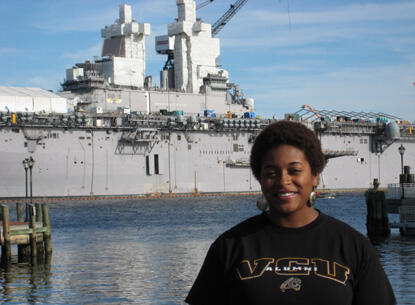
Yet Smith managed to earn her chemical engineering degree in 2009 and today the 26-year-old is working towards qualification as a nuclear shift test engineer on aircraft carriers for the U.S. Navy. (She is one of the first two African-American females working toward successful completion of the program.) And she has Mark McHugh to thank.
“I struggled in every single class he taught and I had a strong dislike of his class,” Smith said. “I thought he made them extra difficult on purpose.”
McHugh doesn’t dispute her.
“A lot of students fight me,” he said. But “our responsibility as teachers is to make sure they learn. If they happen to be your friend, OK, but that’s not why we’re here.”
Smith “started out as a typical college student in the sense that initially she didn’t appreciate the challenge of doing engineering – the amount of work it takes, the amount of effort,” McHugh said. “That slowed her down quite a bit. … In high school, she didn’t know how to work hard. She literally said, ‘I did not know how to study.’”
In fact, at first, Smith received quite a few D’s and F’s on assignments in McHugh’s class. But as his students say, “McHugh helps those who help themselves.” He offered to help Smith if she was serious about chemical engineering, designating an honorary “Amber Smith” chair in his office.
“I remember telling her, ‘I’ll sit with you. If you do the work, I’ll sit with you. But if you come in empty-handed, I’ll kick you out,’” he said.
Smith put in the work, not wanting to waste McHugh’s time. And it paid off: She ended up with the highest grade in her class on the final exam.
“The growth was amazing,” McHugh said. “College worked well for her. She took responsibility for it.”
In time, Smith became grateful to McHugh, saying that he was the professor who had the greatest impact on her.
“I cannot thank Dr. McHugh enough. Sometimes you need someone to humble you,” she said. “I am ever so grateful that my professors knocked me down a couple of notches. … I’m so grateful for the people who were in my life. They did a pretty good job of taking an arrogant little teenager and making her well-rounded.”
For Smith, the foray into chemical engineering started in elementary school when a neighbor gave her a chemistry set.
“I always loved science,” Smith said. “I’ve known I’ve wanted to be a chemical engineer since seventh grade.”
Her father also encouraged her to pursue her dream. Around the same time she received her first chemistry set, her father told her she would become a chemical engineer.
“Go and make me proud,” he told her.
Smith excelled in chemistry — and “tolerated” math — in high school and for college narrowed her choices down to VCU and Delaware State University. The pull of leaving home tipped the scales in Delaware’s favor.
“Being from Richmond, the last thing I wanted to do was to go to school back home,” she said. “It came down to the wire. I went up to Delaware because of course I had to get away from home.”
But after two years, Smith realized she was not progressing sufficiently as a student. She transferred to VCU where fate put her in McHugh’s hands.
As Smith started her final semester at VCU, job prospects after graduation looked bleak.
“This was when banks were tanking – getting a job then wasn’t easy,” Smith said.
Smith didn’t have her sights on the military, but that changed after she attended the University Career Center’s annual career fair in January 2009. She met with representatives from the Norfolk Naval Shipyard and they offered her an interview the following morning. Smith didn’t hear back from them until the day of her last final when they offered her the job. She has been employed at the shipyard for two years and is still in training.
“It takes so long [to train] because you really have to learn everything about nuclear power. They start with everything from the tiniest atom. It’s tough. It’s a lot of information,” she said.
Smith has about one year left before earning her certification. The upcoming year will include five months in shift test engineer school, two eight-hour exams and an oral board examination.
“Sometime this time next year, I will be a qualified shift test engineer,” she said.
Subscribe to VCU News
Subscribe to VCU News at newsletter.vcu.edu and receive a selection of stories, videos, photos, news clips and event listings in your inbox.