Aug. 2, 2005
VCU Faculty Contribute to NASA Tests
Share this story
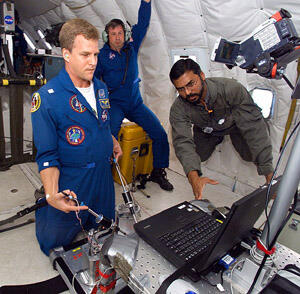
Researchers from the Virginia Commonwealth University School of Medicine are working with NASA to train and test astronauts on surgical techniques that can be used during space flights.
The group also is working with NASA to evaluate a unique physiological monitoring system for space suits.
Faculty members from the VCU School of Medicine’s Department of Surgery will be in Houston Aug. 8 through Aug. 19 to train a team of NASA astronauts on basic surgery skills that could be used in an emergency situation on a space mission. The training sessions will take place on a NASA C-9B aircraft that simulates microgravity through parabolic flight – a series of climbs and dives to achieve weightlessness.
While weightless, the astronauts will be required to demonstrate a set of surgical skills – clip application, suturing and knot tying – using surgical tool kits designed for space flight.
To maximize the training in microgravity, the astronauts will practice the techniques for two days in an earthbound lab, with gravity, before attempting to demonstrate the surgical skills while weightless, according to Azhar Rafiq, M.D., chief scientific officer with VCU’s NASA Research Partnership Center and co-investigator on the project.
They will work at two training stations. The first is a computer generated virtual reality simulation of an abdominal cavity and requires the astronauts to use tools similar to those used in laparoscopic, or minimally invasive, surgery. The second station requires the astronauts to use the clamps, forceps and sutures used in open-wound surgery on an incision in a simulated patch of skin. The real challenge comes in performing the procedures while experiencing weightlessness.
“The best way to train these astronauts is to go beyond demonstration and practice under the most realistic conditions we can produce to measure the amount of force applied to tools and tissue in microgravity,” said Rafiq, assistant professor of surgery. “We have to understand the limits of human performance in such detailed tasks and then we can work to improve their performance and reduce their degree of errors.”
The NASA plane will make 40 parabolas a day during the training period.
“The space community anticipates deeper and more complicated space exploration and the ability to provide trauma and critical care during a mission is essential,” said Ronald C. Merrell, M.D., professor of surgery and chief investigator of the open surgical procedure in microgravity project. “As manned missions move farther out into the solar system, the lag in communications between mission control and the space crew will require a new level of medical autonomy.”
Merrell and Rafiq also are working on a NASA research project involving new space suit sensors. Testing on that project will begin Sept. 12 in Flagstaff, Ariz. The project is called Exploration EVA, for extra vehicular activity, and will test new smart sensors and software to collect data about blood flow and oxygen saturation levels on individual astronauts during space walks or terrestrial activity for geological sample collection. The sensors collect data from a suite of sensors placed on the astronaut’s skin and transmit the signal to a newly designed computer system in the suit’s backpack.
“Currently there is only heart rate monitoring during EVA and that data is not stored or archived,” said Rafiq. “During long-term exploration and long-term terrestrial geologic surveys, mission specialists will want to monitor an astronaut more closely when he is away from the vehicle or the off-world habitat.”
Funding for both projects is from $920,000 budgeted by the space agency to the NASA Research Partnership Center at VCU.
Subscribe to VCU News
Subscribe to VCU News at newsletter.vcu.edu and receive a selection of stories, videos, photos, news clips and event listings in your inbox.