June 30, 2004
VCU Life Sciences sponsors Bioinformatics and Bioengineering Summer
Share this story
Undergraduate students from as far away as Missouri and Oregon are spending their summer vacations at Virginia Commonwealth University learning about a life of research in the emerging world of bioinformatics and bioengineering.
These 16 students, predominantly rising juniors, are participants in the Bioinformatics and Bioengineering Summer Institute (BBSI), sponsored by the Center for the Study of Biological Complexity and the Department of Biomedical Engineering at VCU. Their numbers includes two Richmond city high school science teachers who may take their experiences back to the classroom in the fall. An additional 13 students are back for their second summer in residence. The Institute began its second year of operation on June 7, and students will remain in residence through Aug. 13 this year.
The 15-month program brings in students to begin a research project during their first summer at VCU. The project is continued at their home institution over the academic year, and students return to VCU a second summer to complete the project. Students integrate themselves into the research programs of their VCU mentors, working on projects they propose in consultation with their mentors and collaborating faculty members at their home institutions. Specialized research simulations accelerate the process by which they take responsibility over their projects and assume creative roles. VCU mentors include faculty from the departments of Biology, Chemistry, Biomedical and Chemical Engineering, Microbiology and Immunology, Medicinal Chemistry, Biochemistry, Pharmacology and Toxicology, Human Genetics, Medicine, Oral and Craniofacial Molecular Biology, and Biostatistics.
"We want these students to experience the excitement of a research career in bioinformatics and bioengineering," said Dr. Greg Buck, director of the Center for Biological Complexity. "The students we're getting are fantastic. Many come from four-year liberal arts colleges that don't have engineering or bioinformatics programs. We hope to see some of them matriculate as graduate students at VCU."
Bioinformatics uses computers and information technology to solve biological problems. Represented by the Human Genome Project, bioinformatics is finding its way into many areas of life science research. It relies on the development and application of elegant and powerful computing and mathematical tools that make it possible to create and then analyze massive databases for research answers.
Bioengineering applies engineering principles to the study of medical and clinical problems and includes such topics as tissue engineering, orthopedic biomechanics and rehabilitation engineering.
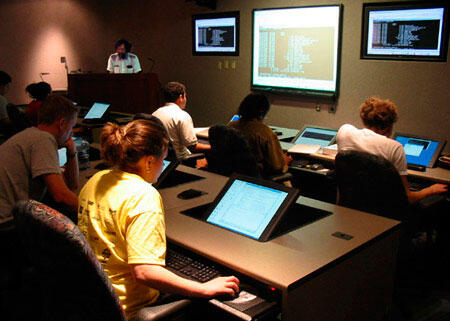
Several biomedical engineering faculty provide lectures during the academic portion of the program and host participating students in their research laboratories. Some of this year’s students are working in the Tissue Engineering Laboratory under Dr. Gary Bowlin, the Speech Recognition Laboratory under the direction of Dr. Gerald E. Miller, and in cardiac electrophysiology.
"The integration of BBSI students into cutting edge biomedical engineering laboratories and academics offers a unique opportunity for these students to learn about a rapidly growing and trend-setting discipline,” said Miller, co-principal investigator of the Institute and chairman of the Department of Biomedical Engineering. “We expect many of these students to learn enough about the field to become attracted to the discipline and join the next generation of biomedical engineers."
The Institute seeks talented students who might be attracted to research
careers in bioinformatics and bioengineering. The mix of talents brought
by the participants is a major strength of the Institute, which is funded
by the National Science Foundation and the National Institutes of Health.
For more information, go to http://www.vcu.edu/csbc/bbsi.
Subscribe to VCU News
Subscribe to VCU News at newsletter.vcu.edu and receive a selection of stories, videos, photos, news clips and event listings in your inbox.