Aug. 28, 2003
VCU researchers combine novel drugs to treat leukemia
Share this story
RICHMOND, Va. – In a prototype of a new, possibly more effective and less-toxic approach for treating leukemia patients, researchers at Virginia Commonwealth University’s School of Medicine and Massey Cancer Center have combined two novel drugs to kill blood cancer cells.
The experimental drugs – UCN-01 and 17-AAG -- appear to work together in a highly synergistic manner to disrupt the cell cycle and inhibit key enzymes in several types of leukemia cells, dramatically slowing their proliferation and triggering apoptosis, or cell death. Because the drug combination is designed to target signaling pathways selectively in cancer cells using relatively low doses of each drug, the combination may avoid some of the side effects of traditional chemotherapy, which attacks all dividing cells.
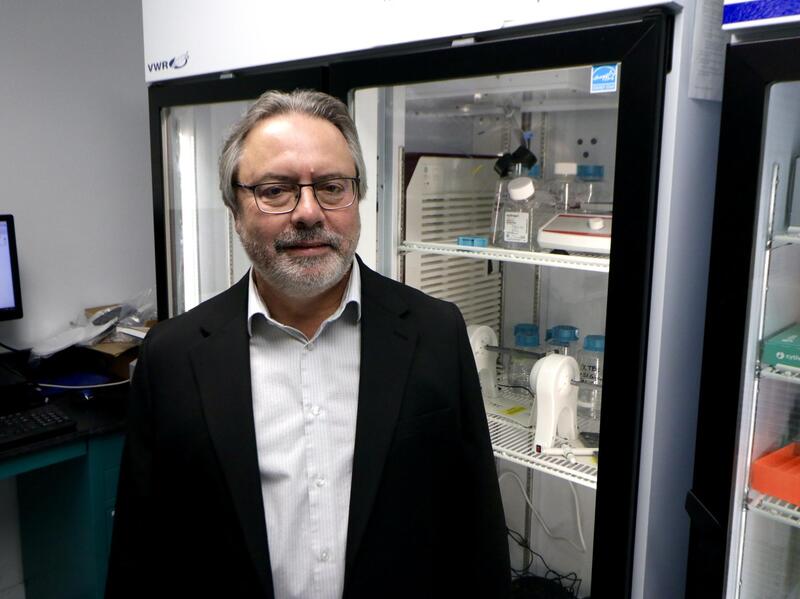
“We have learned that leukemia and other cancer cells are very resilient and activate internal mechanisms to protect themselves against the effects of anti-cancer drugs by stimulating survival pathways,” says Dr. Steven Grant, Shirley Carter and Sture Gordon Olsson Professor of Oncology at VCU and lead author of the study, which is published in the Sept. 1 issue of the journal Blood.
“However, if you disrupt the cell cycle and simultaneously interrupt the cell’s compensatory mechanisms, the cancer cell becomes very vulnerable and can’t escape the effects of this combined approach. The cancer cell then commits itself to a suicide program.”
UCN-01 is a novel anti-cancer drug that has shown promising results in laboratory studies in slowing or preventing tumor cell growth in a variety of cancers and appears particularly effective in triggering apoptosis in blood cancer cells. UCN-01, which now is undergoing extensive clinical trials in humans, is known as a checkpoint abrogator because it interferes with the cell cycle regulation of cancer cells, including cell division and the ability of cancer cells to repair themselves after injury. Laboratory studies have shown that UCN-01’s effectiveness increases, sometimes dramatically, when it is combined with other new cancer drugs or traditional chemotherapy.
17-AAG disrupts the function of a critical protein, Hsp-90 (a member of the heat shock protein family) that is needed by cancer cells for the proper folding and function of a variety of proteins necessary for tumor cell survival. Interference with Hsp-90 function results in degradation of so-called “client proteins.”
Both drugs are under development by the National Cancer Institute, in partnership with pharmaceutical companies in the United States and Japan, particularly for use in treating cancers that have become resistant to other, more conventional anti-cancer drugs.
In this study, VCU researchers exposed leukemia cells to various doses of UCN-01 and 17-AAG, alone and in combination, for 30 hours to assess the interaction of the drugs. The researchers included doses that either were not toxic to healthy cells or were minimally toxic to cancer cells on their own.
At non-toxic levels, neither drug was very effective at killing leukemia cells; the rate of cell death was less than 20 percent. However, when the drugs were combined, the rate of leukemia cell death increased dramatically – to nearly 80 percent of cancer cells.
“We saw tremendous synergism between 17-AAG and UCN-01,” said Grant. “Combining these two classes of novel agents makes the tumor cell very vulnerable.”
Grant and his colleagues at VCU are continuing their research into new classes of targeted drugs and combinations of drugs to treat cancer.
Grant recently took the lead on a multi-center, Phase I clinical trial sponsored by the NCI to test the combination of Imatinib, which is sold in the United States by Novartis Pharmaceuticals Corp. under the trade name Gleevac, and Flavopiridol, made by Aventis, for treating chronic myelogenous leukemia and related leukemias. In addition to VCU’s Massey Cancer Center, other medical centers involved in the trial are Case Western Reserve University, Johns Hopkins University and the University of Pennsylvania.
The trial, which has enrolled its first patients and is expected to last 12-18 months, is intended to establish the safety of combining the drugs and to determine the maximally tolerated dosage in patients. It is the first trial in humans that combines two novel agents that specifically target cell cycle and survival signaling pathways.
Leukemia is a cancer of the blood-forming cells. It begins in the bone marrow – the soft, inner part of the bones -- and then spreads to the blood and often to the lymph nodes, spleen, liver, covering of the brain and spinal cord and other organs. The American Cancer Society estimates that 30,600 new cases of leukemia will be diagnosed in the United States in 2003, and 21,900 adults and children will die of the disease.
The most common symptoms are anemia, increased susceptibility to infection and severe bleeding. Leukemia usually is treated with chemotherapy, radiation and sometimes bone marrow transplantation. Although the survival rate for leukemia has tripled in the last 40 years, the overall five-year survival rate still is less than 50 percent.
Subscribe to VCU News
Subscribe to VCU News at newsletter.vcu.edu and receive a selection of stories, videos, photos, news clips and event listings in your inbox.