Aug. 6, 2010
VCU School of Medicine Student to Present Groundbreaking Research in Japan
Share this story
A medical researcher once said, “Although scientific experiments may be hypothesis-based, scientific progress is guided by our experimental results and data.”
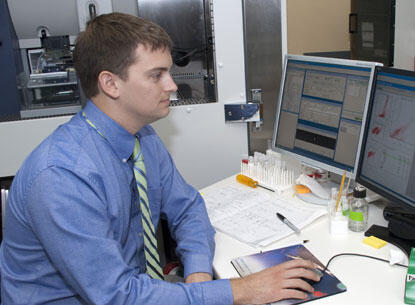
No one understands the meaning of this quote more than Virginia Commonwealth University School of Medicine M.D./Ph.D. candidate David Gibb, whose groundbreaking research began as an attempt to understand allergies and ended up explaining a key element of cancer.
“In general, our work will impact progress in developing treatments for multiple disease states ranging from allergy to cancer,” said Gibb. “More specifically, our research has identified a novel drug target for the treatment of diseases, including b-cell leukemia.”
Gibb’s research focuses on the enzyme ADAM10, which has several different roles, including its particularly important job regulating the formation of antibodies that promote allergic reactions.
In the medical field, at the microscopic level, different elements can often be responsible for several different functions, said Gibb. In Gibb’s case, ADAM10 also was responsible for the control of the differentiation of hematopoietic stem cells – the precursor to white and red blood cells.
Gibb’s research concluded that too little ADAM10 in tests meant that these stem cells would not develop into important antibody-producing cells, and the body as a whole would develop a highly weakened immune system. Too much of the gene and the cells would develop into myeloid cells, influential in the development of cancer.
“Researchers have labeled this enzyme as a target in cancer therapy, and many have been interested in blocking ADAM10,” said Gibb. “They will have to be aware of some of the consequences of those actions which may or may not be beneficial.”
In a few weeks, Gibb will present his findings during two conferences in Japan, including the 14th International Congress on Immunology, a meeting held once every three years to discuss changing trends in the field of medical immunology.
“It’s an absolute honor to share our work with the most well known experts in the world,” said Gibb. “It’s a bit intimidating to stand in front of them and present our work, but the feedback you receive is extremely valuable. Personally, I hope it is one of many great opportunities for me to present to that field as I become part of a worldwide community of immunologists.”
Daniel Conrad, Ph.D., professor of microbiology and immunology at VCU, said that Gibb’s research has led his lab into new directions.
“David has demonstrated the ability to both do his own studies and make collaborative contacts with other laboratories, here in the United States as well as in other countries,” said Conrad, who, as Gibb’s academic adviser, oversaw and funded all of the studies. “This has and will represent an outstanding opportunity for David to meet the top researchers in the field. He has and will continue to represent my lab very well.”
According to Conrad, most graduate students must pay for their own travel expenses and present using a poster when presenting research during conferences. Gibb was awarded a travel grant for his expenses and was invited twice to present his research orally in front of a panel of world-class researchers.
“The travel awards and speaking invitations mostly go to postdoctoral or junior faculty candidates,” said Conrad. “It is a measure of the importance of the studies that has resulted in both the travel awards as well as the invitations to present.”
As numerous breakthroughs in the medical field, such as the invention of penicillin or the discovery of DNA, have shown us, a single element can be responsible for numerous processes.
“Science is full of surprises, and you never know where one question is going to take you,” Gibb said. “For me, I was trying to answer a question about allergic reactions, and ended up generating information important for the treatment of cancer.”
Subscribe to VCU News
Subscribe to VCU News at newsletter.vcu.edu and receive a selection of stories, videos, photos, news clips and event listings in your inbox.