Aug. 4, 2011
VCU Students Export Art Education to Guatemala
Share this story
University service-learning programs usually grow out of existing courses. But Art & Transformation, a joint project between the Department of Art Education and the School of Education at Virginia Commonwealth University, evolved in reverse.
Now in its sixth year, the VCU School of the Arts service is part of the Mayan Arts Program developed by the nonprofit Highland Support Project in Richmond and sponsors in Guatemala. The program started as a service opportunity — an ambulatory program where students could serve as traveling art teachers throughout participating communities in the highlands of Guatemala. Then Jan Johnston got involved.
Johnston, a former high school teacher, joined the program in its first year as a grad student at VCU.
"I started thinking this would be an amazing experience to build a class around," she said. "That's sort of backwards: 'We have a service, let's build a class around it.'"
Since then, VCU's service-learning trip and the Mayan Arts Program have evolved to meet the needs of the local teachers in Guatemala.
"[We] are now trying to train the teachers, so the teachers can advocate and be arts advocates … in their classroom," Johnston, program director, said.
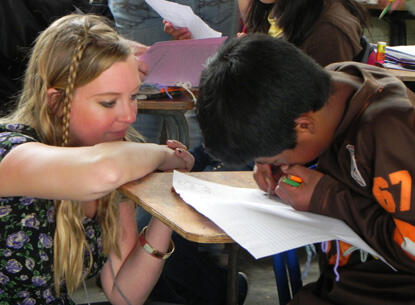
Today, VCU students in the Art & Transformation program work with Guatemalan teachers to prepare lessons based on particular curriculums. The planning process can be arduous; while we're used to instant communication at our fingertips 24-7, the teachers in Guatemala don't have immediate access to email.
"This is kind of like a practicum on steroids in some ways because you're so thrown in, you've got so much to do," Johnston said. "It's such an intense experience. For some of the students that go, it's their first time ever out of the country. And living and seeing some of the things they get to see really is kind of life changing for them."
For the student-teachers, the ability to serve as a positive force in the lives of others is powerful, said Latessa "Miracle" Allums, a rising junior majoring in psychology.
"The impact we made on the children of Guatemala will truly be long lasting,” Allums said. “Through our efforts, I believe we were able to show them that they are capable of doing absolutely anything and that their circumstances do not limit their creativity and the genius they may possess. The joy and happiness in each child's eyes was a priceless moment for me."
Allums stressed the importance of reaching out to other communities. Through international service-learning programs, VCU students get the opportunity to build relationships with community citizens in countries throughout the world, said Lynn Pelco, service-learning director in the Division of Community Engagement.
"By working together with these citizens, VCU students not only share their expertise, but also benefit from the expertise that local citizens bring to the project," Pelco said.
Going abroad also allows VCU students to practice their craft in a challenging environment.
"Trying to balance between participating in all of the planned activities — which lasted from 7 a.m. to 8 p.m. back-to-back most of the days — and finding the time to work on the academic aspect of the program was tough," said Sheila Villalobos, who is majoring in marketing in the VCU School of Business. "Aside from participating in conferences, adjusting the lesson plans, having group meetings and teaching the classes, [we] had to work on journal reflections and plan for final projects."
But experiencing the rich Mayan culture more than made up for the rigorous work schedule, said Villalobos, who attended this summer's program as a Spanish/English translation and interpretation intern.
"What stood out to me about the non-academic aspect was seeing how beautifully traditional the Mayan's culture remained even with the outside influences of the western culture," she said. "My favorite thing about this trip was learning about the culture and customs through the readings given to us a week prior to the trip, and then finally getting to see the reality and how the readings compared to the actual thing."
Two fun and educational projects were borne of this year's arts and literacy theme: comic book-creating and map-making. While the comic book project was writing focused, it also served as a way to share cultural information. The schoolchildren wrote about a family story or a special holiday.
The map-making project involved using maps as a means of communication and art.
The student teachers took a map of Richmond and mapped out their community. They then asked their students to map out their community. The children reflected on what kind of things, — such as buildings or landmarks — make up a community, then made collages of those things. Finally, the students put their individual pieces within a larger map.
"We hope the children and teachers saw these as new methods of incorporating art and literacy into their programs," Villalobos said. "We also hope that they were more aware of their community and the people in it."
The children in Guatemala weren't the only ones who benefited from this project, Villalobos said. "You take a lot back home with you so that it influences the way you see your life in the States."
Subscribe to VCU News
Subscribe to VCU News at newsletter.vcu.edu and receive a selection of stories, videos, photos, news clips and event listings in your inbox.