Feb. 27, 2009
VCU Students Look to Lend a Hand for Spring Break
Share this story

As many VCU students head for the beach during Spring Break or fan out to visit friends and family, a small group of about 80 students will be on a road less taken -- for some, it could be the ride of a lifetime.
They will be participants in Alternative Spring Break from March 7 through March 15, coming face to face with the realities of hurricane devastation, wrenching poverty, the angst of disability. They’re also likely to be butting up against conflicting philosophies and different religions.
Frankly, that’s why many of them chose the hard road of Alternative Spring Break in the first place.
“Alternative Spring Break has helped me grow as a person, and I’m extremely grateful for that,” said Alicia Mathes of Mechanicsville, a junior majoring in Community Health Education. “It has taught me there isn’t one way to do life, and there isn’t one set of beliefs that everyone has.”
This year, VCU students will be building homes for the homeless in La Esperanza, Honduras, and Phenix City, Ala. They’ll be helping the still shell-shocked residents of Galveston, Texas, recover from a devastating hurricane.
In Mayville, Mich., they will be working with a professional staff to bring a sense of normality and purpose to the lives of people facing mental and physical challenges ranging from autism to traumatic brain injury.
Three other spring trips will take students to New Haven, Conn.; Orlando, Fla.; and Oakhurst, N.J.
On those trips, where they will be involved in everything from painting and cleaning up cabins at a camp for disabled children to working with professionals who are trying to encourage chronically homeless adults to break the cycles of addiction that led them into homelessness.

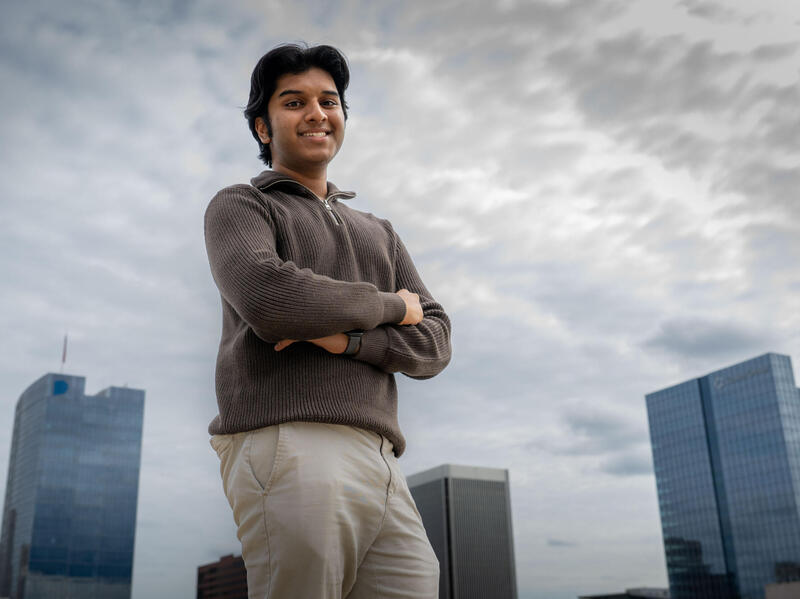
Roshan George, president of Alternative Spring Break, had his epiphany about the value of helping others on a trip three years ago to New Orleans, which was still digging out from Hurricane Katrina.
George, a biomedical engineering major from Midlothian, initially enlisted for Alternative Spring Break for a self-serving reason – to enhance his resume for medical school.
But when he began pulling out family pictures and children’s toys from the muck of a shattered home in New Orleans, the elderly couple who owned the home wept.
George wasn’t prepared for what happened to him. His heart broke.
“Two days earlier, I was watching [the New Orleans cleanup] on TV, and I had absolutely no emotional attachment. Then I was there.”
He found connection, he found passion and he found the strong sense of selfless service that underlies the mission of Alternative Spring Break.
Participants in Alternative Spring Break work to raise money during the year to help meet their budget, which this year totals $22,000. To raise money, students worked concession stands at Kings Dominion, helped out at a hotrod event and hosted a family day celebration for a major soft drink company.
Participants also pay $150 each to finance their trips, although international trips typically require a larger investment; this year’s trip to Honduras will cost $1,100 including airfare, food and lodging. In addition, the VCU Student Government Association makes a contribution to help with the costs.
One of George’s goals this year is to restructure Alternative Spring Break so that it qualifies as a federal non-profit organization, which would enable it to solicit corporations for funding.
Universities that have done that have been able to greatly expand their outreach and level of participation, he said.
Harjot Grover, a junior biology major from Troy, Mich., said there is not only a lot of service during Alternative Spring Break, but also a lot of learning.
She said she will never forget how much she learned on a trip to Key Bisque, Fla., to work on an environmental cleanup project.
“We worked with many different plants, and I really felt like I learned more in that one week then in any of my biology courses,” she said.
Grover said she also will never forget the alligators in the Everglades, but that’s another story.
Many of the students who go on Alternative Spring Break talk about the bonding experience they have with other students.
The long van rides to their destination and back – this year’s trip to Galveston, Texas, will take about 24 hours one-way – is one part of that bonding. The laughs and tears they share on their projects also bring them closer together.
Alicia Mathes recalled her trip back from Alabama on a project. The Alternative Spring Break van unloaded in front of Brandt and Rhoads halls in a pouring rain, but Mathes said the members of her group were oblivious to the rain and their soaking clothing.
“We all stayed around and reminisced about the trip, and hugged each other,” she said.
Subscribe to VCU News
Subscribe to VCU News at newsletter.vcu.edu and receive a selection of stories, videos, photos, news clips and event listings in your inbox.