April 21, 2006
VCU-PSU research team receives award from Army Research Office to develop superatoms
Share this story
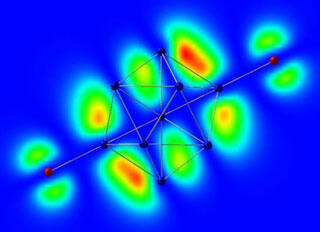
A team of Virginia Commonwealth University and Penn State researchers that last year discovered a new form of chemistry has received an award from Army Research Office totaling nearly $5 million to develop new materials known as superatoms.
The research team had demonstrated that aluminum clusters can act as halogen or alkaline earth elements, thus extending the periodic table to a third dimension and allowing for the creation of new families of nanoscale materials with extraordinary attributes.
In a joint experimental-theoretical work on the reaction of aluminum clusters with iodine, researchers had shown that Al13- and Al14++ cluster anions can behave as a super halogen or alkaline earth entity, respectively. The work focused on naturally occurring chains or networks of iodine atoms and molecules known as polyiodides. When aluminum cluster, Al13-, was substituted for an iodine ion, the entire chemistry of the compound changed, causing the other iodine molecules to break apart and bind individually to the cluster.
According to the researchers, the production and stabilization of such species is a stirring development as it opens a new branch of chemistry and material science, showing that these “superatoms” can be used as building blocks to form new nanoscale materials that could lead to new applications in medicine, catalysis, sensors and other fields.
The results of the research, headed jointly by Shiv N. Khanna, Ph.D., professor of physics at Virginia Commonwealth University, and A. Welford Castleman Jr., the Evan Pugh Professor of Chemistry and Physics and the Eberly Family Distinguished Chair in Science at Penn State, were reported in the Jan. 14, 2005, issue of the journal Science.
The PSU group will carry out lab experiments, while the VCU group will work on theoretical studies to determine how best to develop the new materials.
Subscribe to VCU News
Subscribe to VCU News at newsletter.vcu.edu and receive a selection of stories, videos, photos, news clips and event listings in your inbox.