Sept. 11, 2007
VCU-PSU researchers discover a strong and highly stable aluminum-hydrogen cluster
Share this story
A team of Virginia
Commonwealth University and Penn State University researchers has
created a highly stable aluminum-hydrogen cluster that may one day be
used to advance propulsion systems that launch rockets or create new
storage systems for large quantities of hydrogen fuel.
An
important step toward achieving a hydrogen economy and creating
alternative fuel sources is the identification of new species that can
bind hydrogen and release it when needed.
The VCU-Penn State
collaboration also provides a base of knowledge and insight into the
factors controlling reactivity of aluminum clusters and how the
addition of a few hydrogen atoms can turn the otherwise-reactive
clusters into air-stable species ideal to make aluminum-particle based
materials for fuels.
Through a team effort combining
theoretical work by Shiv N. Khanna, Ph.D., professor in physics at VCU,
and his team, and the experimental work by researchers led by A.W.
Castleman Jr., Ph.D., a professor at Penn State University, the team
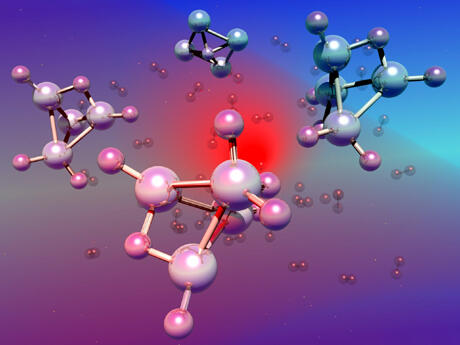
identified Al4H7- to be a highly
stable species ideal for making materials. The work was published in
the Proceedings of the National Academy of Sciences Online Early
Edition the week of Sept. 3, and appears in the print issue Sept. 11.
“The
main objective of our work is to make materials where clusters of atoms
serve as the building blocks. The properties of clusters can be
controlled by size and composition, which offer a novel way of
synthesizing materials with desirable combination of properties,”
Khanna said.
“It is important to find ways in which materials
with aluminum particles can be synthesized that will not oxidize under
ordinary conditions. The findings indicate that Al4H7- is highly stable and has properties that should allow the synthesis of cluster materials using these units,” said Khanna.
Aluminum
particles are used for high energy fuels – producing a lot of energy as
they burn. For uniform burning, small particles are favored. However,
aluminum is easily oxidized and small particles are often coated with a
dead oxidized layer composed of already burned aluminum.
“Finding
ways in which the dead oxidized layer can be eliminated, leading to
aluminum particles that will burn completely when needed is a giant
step toward aluminum based fuels,” Khanna said. This work indicates
that the addition of a few hydrogen atoms can provide the desired
particles.
The team generated aluminum-hydrogen clusters (Al4Hm-)
by exposing aluminum vapors into hydrogen gas. The strength and
stability of the aluminum clusters was tested by exposing them to
oxygen.
Researchers observed that Al4Hm- clusters containing an even number of hydrogen atoms reacted immediately when exposed to oxygen. However, Al4Hm- clusters containing an odd number of hydrogen atoms were significantly less reactive. In particular, Al4H7- was found to be extremely stable and resistant to oxidation.
“Our
theoretical studies uncovered the reasons for this special stability
and showed that the cluster consists of a core of aluminum atoms
decorated by hydrogen atoms. The theoretical studies also predicted
that it has a high electron affinity, an attribute needed to make
cluster materials out of cluster motifs,” Khanna said.
Khanna and Castleman collaborated with Art Reber, a postdoctoral associate in Khanna’s group in the Department of Physics
at VCU; and W.H. Woodward, and P.J. Roach, both research associates in
the Departments of Chemistry and Physics at Penn State University.
Subscribe to VCU News
Subscribe to VCU News at newsletter.vcu.edu and receive a selection of stories, videos, photos, news clips and event listings in your inbox.