Feb. 11, 2026
What can two dresses tell us about the lives of Black women in the 19th century?
Share this story
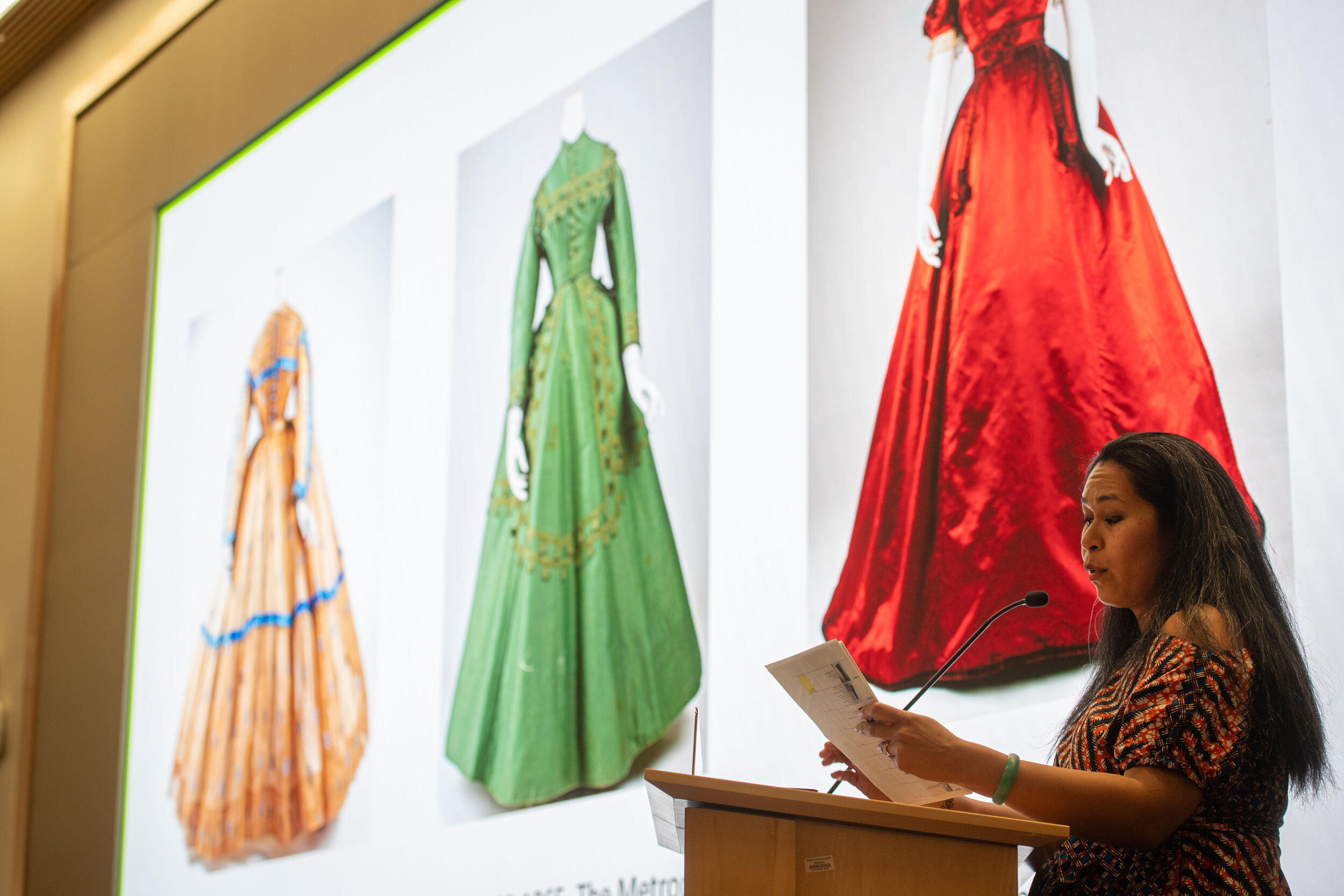
On a large screen at James Branch Cabell Library is an image of a white cotton dress. On the surface it looks like many other dresses made in the 1860s – dropped sleeves, a defined waist and a long, wide skirt were all hallmarks of that era. However, what appears to be an ordinary piece of clothing actually tells a story about who its previous owner was and what her life was like.
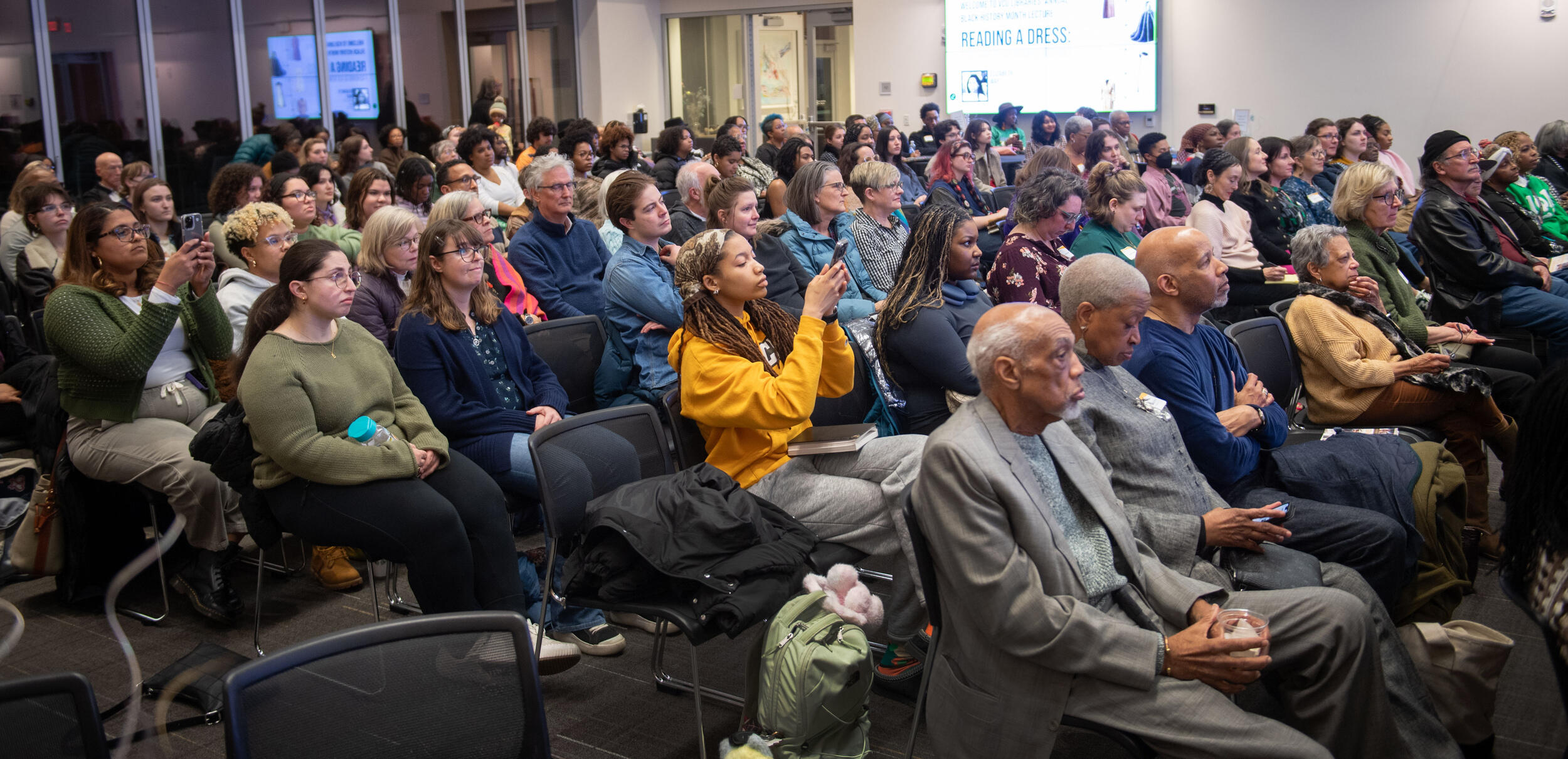
This was one of Elizabeth Way’s primary lessons during “Reading a Dress: Fashioning Black Women’s Histories,” VCU Libraries’ 2026 Black History Month Lecture that was held last week.
“The history of fashion can explore many facets … through material culture study it can point us to objects that illuminate historic people's lives, their artisanship, and even perspectives,” said Way, Ph.D., a costume and accessories curator at the Museum at the Fashion Institute of Technology. “Putting all these pieces together can give us access to people who have not been recorded in history books or commemorated in statues or plaques, but who nonetheless have significantly contributed to our shared American history through their everyday experiences.”
A white dress
The dress on the screen was owned by Sarah Tate, a recently freed woman in rural Texas. The garment was one of a few artifacts she left behind, with the only other information about her from census data. So what can it tell us about her and her life?
Tate was freed after the Civil War in 1865, and she went from working as a house slave to being a paid employee. She used her first paycheck to buy fabric to make the dress. Way said Tate was making a powerful statement by using the first money she earned to align her outer appearance with her inner self.
“The cotton dress we focus on here declares another identity: free woman,” Way said.
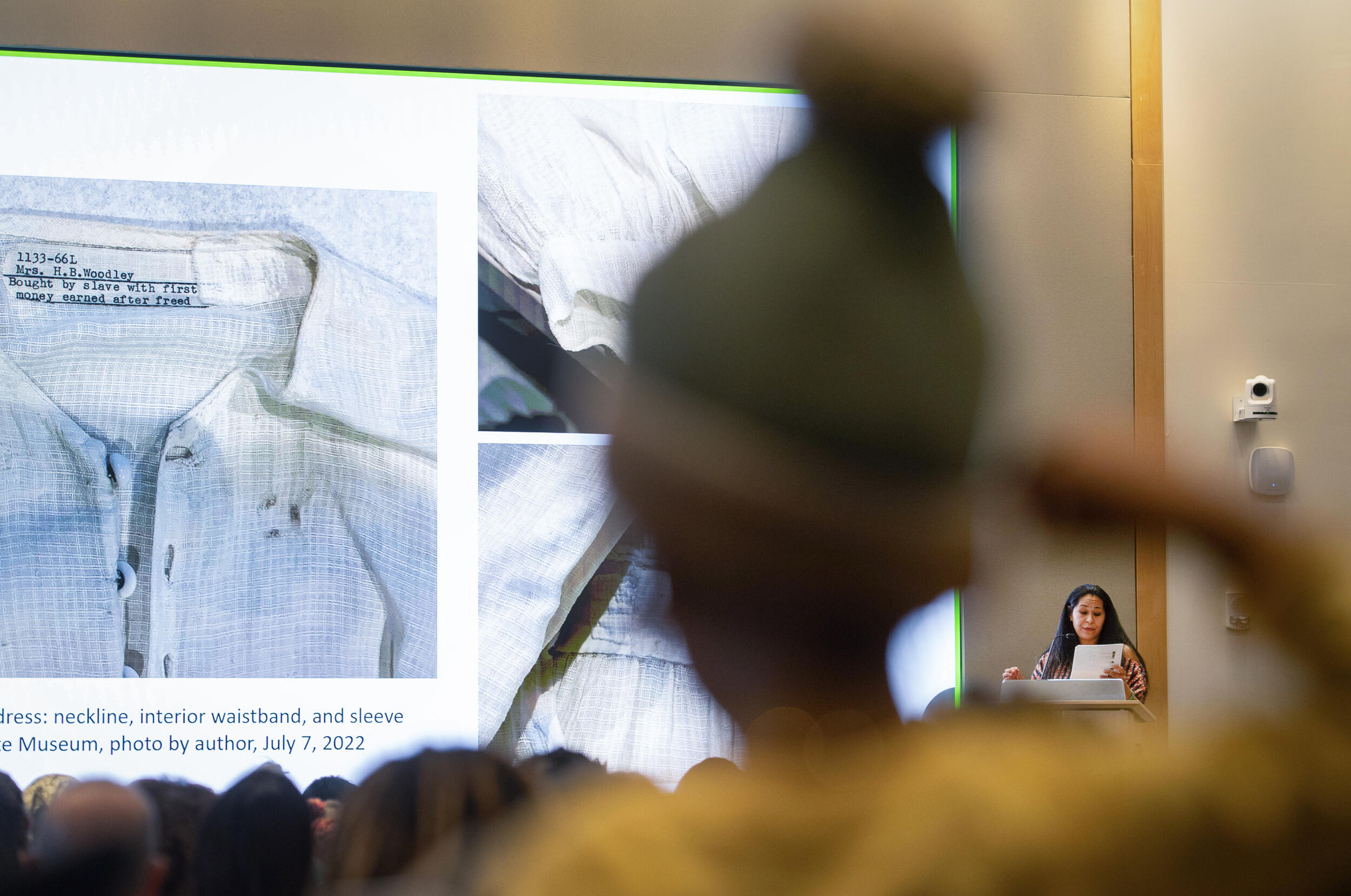
One of the reasons this is notable is because during the antebellum period, clothing was a way for enslavers to control and demoralize enslaved people. Way said plantation owners often bought cheap cotton cloth called “Negro cloth” to clothe enslaved people.
“This, and similarly drab, uniform and poor-quality clothing marked people out as enslaved,” Way said.
However, enslaved people would rebel against this by buying, trading for, and stealing new and secondhand clothing. They also dyed, altered and embellished their garments.
“They personalized and beautified the clothing they wore, because the way they dressed was an important expression of themselves as humans,” Way said. “They fought hard against efforts to erase their humanity.”
While Way added she didn’t know how Tate dressed while enslaved, these circumstances would explain why getting a new dress would be a priority to her. Other objects of Tate’s that survived were a baby dress from her deceased child and a Bible. Way mentioned that the scholar Katie Knowles has pointed out that Tate was the guardian of her own history, and the object she curated in her private archive commemorated the many roles played in her life, “including daughter, sister, wife and mother.”
“We know from her archive that she thought of herself as many things, none of which related to her enslavement,” Way said.
An olive dress
The second dress showcased during Way’s lecture belonged to a Black woman who was born 12 years after Tate but who lived a very different life.
What did the solid olive green, silk dress from 1873 tell us about its owner? While also a formal dress, the second has a more complicated, form-fitting cut, fancy trim, fine fabric and “an up-to-the-minute interpretation of Paris style.”
“It clearly belongs to a woman of some means who is closely following the latest developments in fashion,” Way said.
Despite the dress’s expert craftsmanship, two details on the overskirt indicate an informal homemade quality. There are fabric knots at the waist that are placed under the bodice and the waistband is irregularly pieced from bits of fabric on the right side of the skirt.
“Even though these details are hidden from view, they suggest an intimacy and easiness between the maker and the wearer,” Way said. “They are not details that a professional dressmaker would leave in a dress made for a paying customer.”
This dress was owned by Rebecca Primus, who was born in 1815 to two highly respected Black Hartford citizens. Her great-grandfather, Gad Asher Ashe, won his freedom fighting in the Revolutionary War. Her father, Huldreich Primus, was one of 35 Black property owners in Hartford, out of a population of 714 black residents in 1860. Her mother, Rebecca Primus, came from a family that helped establish Hartford's first Black church and first Black school.
“With such respectable parents, Rebecca Primus, along with her four siblings, was launched into the world with every advantage a Black woman could expect at this time,” Way said. “She was well-educated and trained in education. She worked as a teacher, running her own school for Black children in Hartford by at least 1860.”
While the family was middle-class, the Primuses also took on odd jobs in addition to their full-time jobs – unlike most white, middle-class families -- and Rebecca worked full-time as a dressmaker. Because of her mother’s occupation and the minor flaws with the dress (despite otherwise perfect craftsmanship), Way said it was likely that Rebecca’s mother made it for her.
At 29, Rebecca traveled to Royal Oak, Maryland to establish a school and taught newly emancipated children. She was the only Black teacher sent by the Freedmen's Aid Society for this program.
While down in the more southern state, Rebecca often critiqued the way members of the Black community dressed and conducted themselves. These were in stark contrast to her upbringing in Connecticut, and the established etiquette of her more urban home.
“[Rebecca] values her ability to follow the fashions endorsed by the mainstream and present herself as a lady,” Way said. “Her criticisms of Royal Oak's fashion choices might seem priggish and judgmental to us today, but they also remind us that Black Americans were not a monolithic group during the 19th century, just as they are not now. They came from different classes and regions and different cultural values.”
However, it is also important to note that even with her fashion policing, coming down to Maryland directly after the Civil War to teach and help raise money for a new school put her at significant risk.
“Rebecca, like other middle-class Black women activists, moved beyond the domestic sphere in ways that would have been much more questionable for a respectable white woman,” Way said. “Though her role as a teacher remains within the norms of feminine employment, she takes on the risk and responsibilities because she knows that Black Americans with education and opportunity can live stable, contributive, even aspirational lives.”
Way ended the lecture saying both of these women came from a generation and communities who weaponized respectful fashion to fight for their dignity and demonstrate themselves as worthy Americans.
“The act of dressing fashionably and respectably not only expressed middle-class femininity, true womanhood and economic spending power, it also contributed to the political discourse of respectability,” she said.
Subscribe to VCU News
Subscribe to VCU News at newsletter.vcu.edu and receive a selection of stories, videos, photos, news clips and event listings in your inbox.