Oct. 5, 2010
VCU Hosts Open House for Newly Renovated Center for Human Simulation and Patient Safety
Share this story
The newly renovated Center for Human Simulation and Patient Safety opened its doors this fall to university officials, faculty, staff and students who had a chance to tour the new facility, participate in simulation demonstrations and meet the center’s new staff.
The center, which is a collaboration between the VCU School of Medicine and the VCU Health System, provides simulation-based training for faculty and medical students of the School of Medicine as well as for trainees and staff of the VCU Health System.
“This is truly a unique resource because it allows for training across the spectrum - medical students, residents, staff and physicians,” said Jerome F. Strauss, III, M.D., Ph.D., dean of the VCU School of Medicine. “It was also built on interdisciplinary collaboration with the established programs in nursing and allied health and they’ve been invaluable. This has been a great opportunity to share information, to share ideas and to build very powerful tools to educate health care providers.”
The approximately 5,000-square-foot space includes two large simulation labs that can be outfitted as operating rooms, intensive care units or multibed acute care environments; task trainer rooms; and inpatient rooms. All are wired with video cameras and microphones. There also is a classroom with debriefing capabilities, a control room and storage areas.
The video cameras and microphones in the simulation rooms feed back to the control room, allowing instructors to record participants in the simulation scenarios and play them back in debriefing sessions. Participants can learn without placing patients at risk.
“Simulation is the future of multidisciplinary team training for learners in the environment and for the ongoing educational needs of our clinical and support staff,” said John Duval, CEO of MCV Hospitals. “Safety demands now and going forward that medicine be a team sport and we need to bring all the disciplines together around clinical care. Simulation provides that educational platform to do that in a safe and controlled and appropriate environment.”
The Center for Human Simulation and Patient Safety provides medical education across the continuum and enhances patient safety and quality of care through education and research in clinical simulation.
Close Encounter with a Simulator
The man lying in front of us on the gurney was losing blood at an alarming rate. The bullet had tunneled through his left arm, just above his elbow, and exited only to re-enter his body through his lower left abdomen and pierce his stomach. We were informed he’d been caught in gang-related crossfire. We applied pressure to the wound to prevent further blood loss. We tied a tourniquet. It was hard to think fast, harder to act on it.
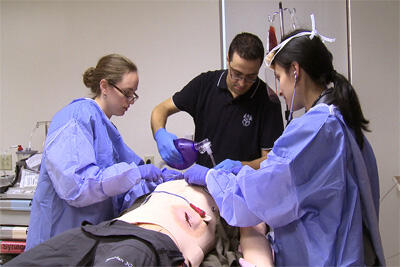
He cried out in pain before he began slipping in and out of consciousness. We monitored his pulse which was stable at first, but then we lost it. Moments later, we began chest compressions – our team leader instructed another team member to keep the beat by humming the Bee Gees’ tune “Staying Alive.” The pace of activity in this ER was still fast and furious.
But then the team leader pointed out the chest compressions were being done incorrectly – we were too low on the patient’s chest. She repositioned the hands of the team member administering them and noted the landmark we should use as a guide.
The teaching moment was useful – and fortunately, we weren’t putting the life of our gunshot victim in further peril, since he was a fully wireless, portable patient simulator that closely mimics the anatomical workings of the human body.
Although I’m not a medical student or a health professional - my medical training is limited to what I’ve absorbed from watching popular television hospital dramas - this brief experience in a mock ER at the Center for Human Simulation and Patient Safety made it very clear to me the value of simulation and a simulation-based education system. The environment was controlled, no harm could come to the patient-simulator and learning and practice was taking place at every turn.
“Through simulation, participants can take their knowledge and apply it to a clinical setting … it’s a merging of clinical and cognitive knowledge in a place that doesn't harm anybody,” said Ellen L. Brock, M.D., medical director of the Center for Human Simulation and Patient Safety.
VCU School of Medicine students and health care professionals of the VCU Health System who train at the center are also able to have their scenarios and interactions recorded and played back to them during the debriefing session that typically follows the simulation activity. Instructors are able to control the simulators and watch the activities from the center’s control room.
According to Brock, by removing the instructor from the room where the scenario is being played out, the participants can better observe, assess and manage the simulation activity in front of them. During the video playback, the participants can see themselves working, and as Brock puts it “you get a meta-view of what you are doing” – and that’s where the real learning takes place.
“It’s important that we keep up with and lead the trends in teaching medical students and residents and nurses and teams of healthcare providers to work in the way that we want them to work – and simulation is a valuable education tool in that regard,” said Brock.
Subscribe to VCU News
Subscribe to VCU News at newsletter.vcu.edu and receive a selection of stories, videos, photos, news clips and event listings in your inbox.