Feb. 18, 2026
VCU expert Allison Moore unknots the complexity of one of civilization’s oldest ideas
Share this story
If you've ever felt tied up in knots, consider the plight of mathematicians!
One of the discipline's intriguing concepts is knot theory, which explores the properties of closed curves in three-dimensional spaces. Recent research has further highlighted the complexity of the calculations, but let's leave that to the pros.
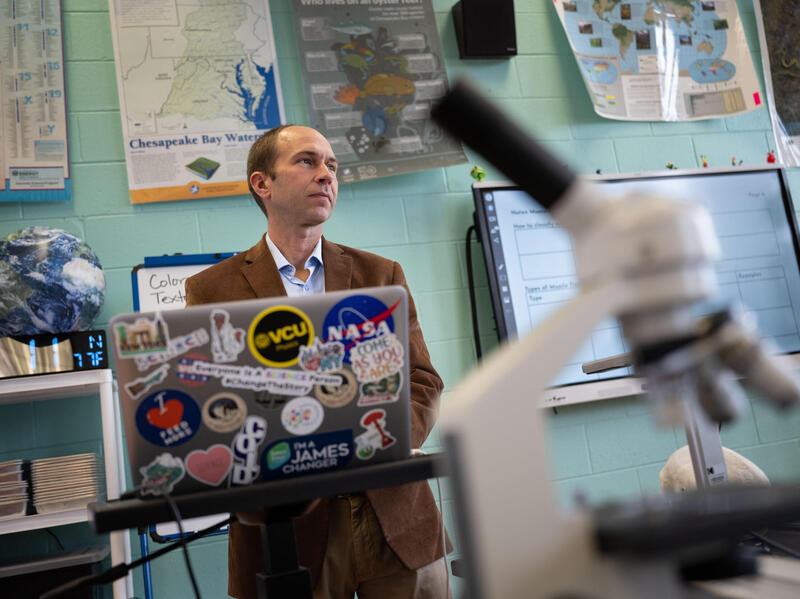
For a user-friendly overview of what we might appreciate about knots, VCU News caught up with Allison Moore, Ph.D., an associate professor who specializes in knot theory in the Department of Mathematics and Applied Mathematics in the College of Humanities and Sciences.
First, the big picture: People often reflexively say they're “bad at math,” or they presume everything about math is complicated. Give us a quick elevator pitch of sorts for why we should embrace math – in both the small sense and the larger sense.
I want to encourage most people to think of mathematics the way we approach art or music: from an appreciation perspective. I cannot paint like Rembrandt or sing like Sade, but I still really enjoy art and music. You don't have to have particularly good mental math skills in order to appreciate the degree to which math and mathematical algorithms influence our lives. Math concepts and algorithms are just about everywhere: from the low-tech (kitchen measurements, medicinal dosages) to the high-tech (Siri suggesting a song or a route to work), and from the mundane (calculating a tip) to the exciting (calculating a trajectory for a moon landing) and the fun (sports stats).
I also think there is an unfortunate misconception that being slow with a math calculation or concept somehow makes a person “bad at math.” In fact, most of the high-level mathematics being done today is developed at a relatively slow pace. It takes time and effort to think through something complicated, and that's OK.
So, why should we care about knots, and what can they tell us?
Knots have been a part of human civilization for tens of thousands of years. For example, ancient cultures in the central Andes were using knots tied in cords (called “quipu”) for complex record-keeping around 2000 BC. Knots certainly have a long history of practical purposes, but also appear in art, spirituality and religion.
For a more modern and scientific perspective, knots are quite central in mathematics. Knot theory is a big part of topology, which is a branch of math where we study properties of spaces and shapes. The work of doing knot theory involves many different kinds of mathematics: geometry, algebra, combinatorics and analysis.
So, if you're already in the business of doing advanced math, knots are pretty cool and studying them can often lead to surprising discoveries. Outside of math, knot theory and topology have applications in physics, chemistry, molecular biology and data science, to name a few.
Can you describe a simple knot and how knot theory, or the math itself, is at work?
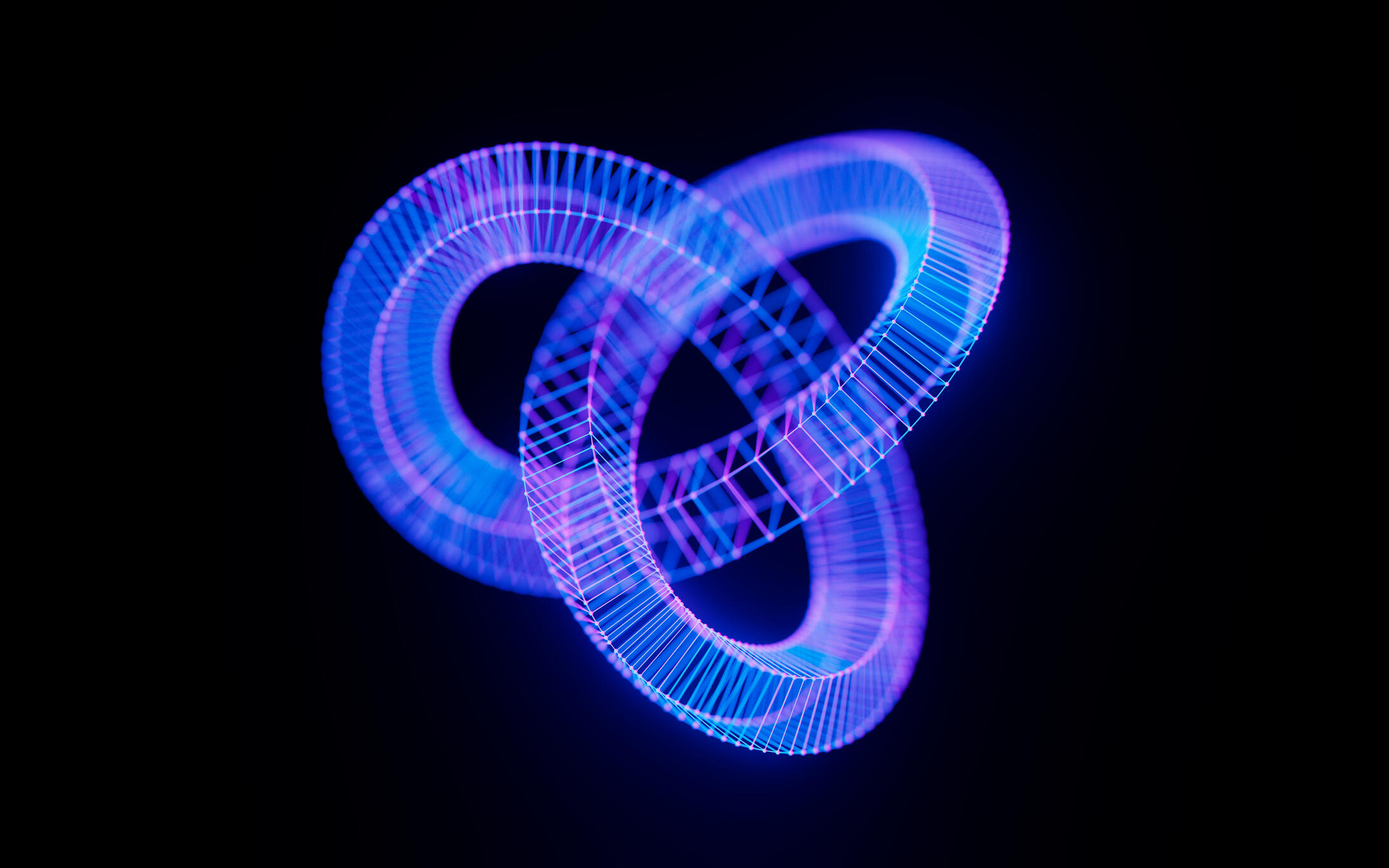
The simplest mathematical knot is the trefoil: It has three crossings. Anyone can create a trefoil by simply tying an “overhand” knot in string and joining the ends (because in math, a knot needs to be a continuous loop). Yet even this basic knot demonstrates an important mathematical property: chirality. The overhand knot can be tied in a right-handed or left-handed fashion. The resulting mathematical knots are different from each other; the right-handed and left-handed versions of the trefoil cannot be transformed into each other without cutting or retying. We actually need to do some real math to prove that they are truly different knots.
You've participated in VCU Geometry Camp, a weeklong summer day camp for middle school students. Do you introduce them to knots – and how and why?
Oh, absolutely – knot theory is one of my favorite topics at Geometry Camp. We did a variety of activities involving knots, links and braids. Campers learned about tangles and investigated a rather subtle counting problem that was posed in the language of braids.
In the second camp, students were asked to solve a puzzle involving picture frames hanging on nails that has an unexpected solution related to linking. We also play a fun camp game called “the human knot” where a group of kids joins hands and then tries to untangle. It's a hoot!
Knot theory is ideal for camp because knots and braids are quite literally hands-on. As we tie knots, our hands become busy and our minds become active. The math problems are real and substantial, but framing the puzzles in the language of knots or braids makes the math fun and engaging.
Is there an angle tied to knot theory that might surprise readers?
I think most people would be surprised to find out that knot theory can be useful for modeling enzymatic actions in DNA. There's a whole branch of mathematical biology called “DNA topology" that's dedicated to this concept. It's very interesting.
Subscribe to VCU News
Subscribe to VCU News at newsletter.vcu.edu and receive a selection of stories, videos, photos, news clips and event listings in your inbox.